You are not logged in.
Pages: 1
- Index
- » Analyses / Forecasts (by major banks and brokers)
- » EUR/USD: has the pair hit bottom?
#1 06-05-2020 11:18:21
- johnedward
- Admin & Trader

- From: Paris - France
- Registered: 21-12-2009
- Posts: 3861
- Website
EUR/USD: has the pair hit bottom?
EUR/USD: has the pair hit bottom?
(the implications of a double combination)
One of the most common schemes in Elliott wave theory, a double combination involves two single corrective waves connected by an intermediate segment. It appears in various places - the second wave of an impulsive motion, the "A" wave of a triangle, etc. - and the third wave of a correction wave.
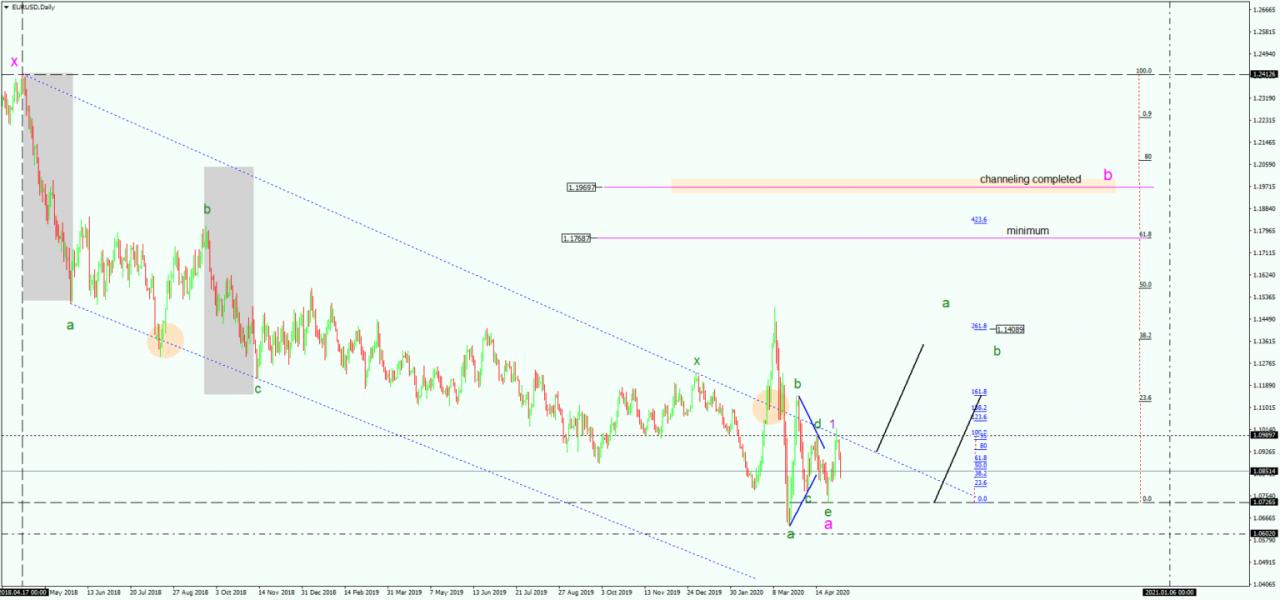
The corona situation led to a high demand for USD. Investors rushed to the safety of the USD and sent it up as the stock market lost more than 29% of its value.
However, over time, the USD is losing strength and reversals are forming on various charts. The eurodollar pair, for example, appears to have put an end to a dual combination pattern that began two years ago. At that time, the pair was trading well above 1.19, could history be about to repeat itself and threaten such levels again?
Has the eurodollar pair reached the bottom?
Until the recent triangular consolidation at the end of the double combination, there was little to no rebound in the price action of the eurodollar. In fact, no segment has retraced more than 62% of the previous market swing, making it difficult for traders to have a contrarian viewpoint.
As it turns out, it has been difficult to pick a floor for the pair for the past three years. Could it be that the recent move to the 1.075 zone is the new floor for the near future?
The double combination that channels against the 0-x trend line is the key. The recent movement above 1.10 following the ECB press conference recently met resistance at the 0-x trend line. The reaction of the dynamic resistance was so strong that the pair dropped a couple of hundred points in an almost vertical movement.
However, the bullish technical case seems convincing here. The market has already retraced 62% of the movement towards the 0-x trend line, from high to low.
According to Elliott wave theory, the 50-62% retracement is the ideal place to enter the extended third wave. If this is the case, the eurodollar pair could go above 1.10 sooner than expected.
Nearly a century ago, Ralph Elliot believed that markets move for a reason. Moreover, when they move, they move in waves, forming patterns and cycles of varying degrees. The system he created uses impulsive and corrective models to explain market behaviour.
If the double combination presented here is true, then the pair has ended a bearish trend that took more than a year and a half to form.
What lies ahead may not be so bearish after all!
"Anything worth having is worth going for - all the way." - J.R. Ewing
Offline
Pages: 1
- Index
- » Analyses / Forecasts (by major banks and brokers)
- » EUR/USD: has the pair hit bottom?