You are not logged in.
Pages: 1
- Index
- » Analyses / Forecasts (by major banks and brokers)
- » EUR/USD: What's next for the dollar?
#1 04-11-2020 10:10:09
- johnedward
- Admin & Trader

- From: Paris - France
- Registered: 21-12-2009
- Posts: 3861
- Website
EUR/USD: What's next for the dollar?
EUR/USD: What's next for the dollar?
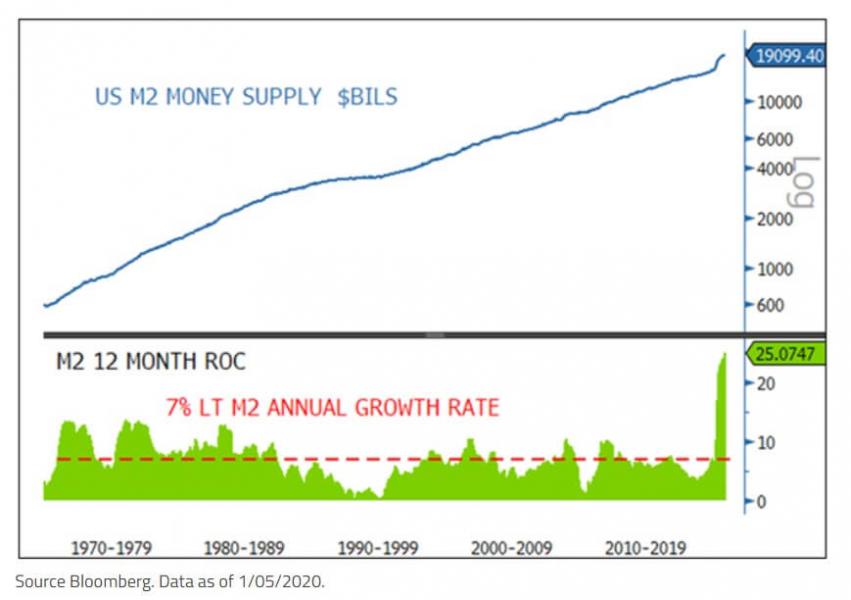
The extreme response to the virus crisis by the United States Federal Reserve can easily be identified. While the money supply and institutional money market assets grew from 2005 to this year, the growth rate accelerated dramatically as a result of the virus situation.
Inevitably, a chart like the one below calls into question the very definition of the strength or value of a currency. An increase in the money supply leads to a decline in value, as we will see from the beginning of the economy. However, not only has the USD not lost any of its value during all these years, but it has actually strengthened.
How is this possible? The answer comes from the exorbitant privilege of owning the world's reserve currency. This is why the demand for dollars far outstrips Treasury issues or the rate at which the Fed is creating digital dollars through the quantitative easing programme.
Who lends to the US?
The basic economic concept applies to any government or central bank that increases the money supply to devalue the currency. Because there is no other side to the equation, money will eventually lose value.
In the case of the United States, things are different because of its status as a reserve currency. Other currencies are also used as reserves, such as the EUR or the yen, but not as much as the USD.
Who lends money to the US? It is one thing to issue debt like the Treasury does, and another to find buyers for that debt. These buyers are well aware of the above table - but they believe the USD will retain its value over time, so they continue to bid for USD-denominated debt issued by the U.S. Treasury.
China and Japan buy more than 32% of U.S. debt. These two countries alone are responsible for financing one-third of the money the US needs to finance its deficit. The other countries each contribute a small share. For example, the United Kingdom buys 4.8%, Brazil 5.0%, and Luxembourg 3.4%.
We won't list all the countries because the list is terribly long. The fact is that one can issue more dollars, as shown by the increase in the M2 index and institutional money market assets, without the value of the dollar decreasing. The explanation is quite simple: by issuing new debt and finding buyers for it, other countries around the world are willing to buy it, overcoming the supply of USD with a strong demand.
If demand is stronger than supply, the dollar will appreciate. As in all these years, just remember that the EUR/USD was trading at 1.59 or the GBP/USD at nearly 2 just 10 years ago.
"Anything worth having is worth going for - all the way." - J.R. Ewing
Offline
Pages: 1
- Index
- » Analyses / Forecasts (by major banks and brokers)
- » EUR/USD: What's next for the dollar?