You are not logged in.
Pages: 1
- Index
- » Analyses / Forecasts (by major banks and brokers)
- » EUR/USD: the pair is closely following the US consumer index
#1 20-05-2021 13:29:55
- johnedward
- Admin & Trader

- From: Paris - France
- Registered: 21-12-2009
- Posts: 3861
- Website
EUR/USD: the pair is closely following the US consumer index
EUR/USD: the pair is closely following the US consumer index - What does this mean?
The EUR/USD had one of the strongest performances on the currency chart in the last 6 weeks. What does the rest of the year hold?
The EUR/USD is often considered one of the most important currency pairs on the currency chart. Indeed, it accounts for about half of the dollar index, and the EUR/USD is therefore considered a benchmark for dollar strength or weakness.
During the first quarter of the year, the EUR/USD lost several big numbers (i.e. several hundred pips). It traded up to 1.23 and beyond in January, only to fall back to 1.17 towards the end of March.
But then everything changed. The ECB's reluctance to extend the PEPP programme, its inability to communicate its intentions to the market and the Fed's willingness to maintain an accommodative stance created a bullish environment for the EUR/USD. Since the beginning of April, the pair has risen from 1.17 to 1.22.
However, there is another interesting correlation to watch in the month ahead. Despite what the Fed and ECB may or may not do, the pair has been closely tracking the difference in core inflation, or five-month forward inflation relative to US core CPI.
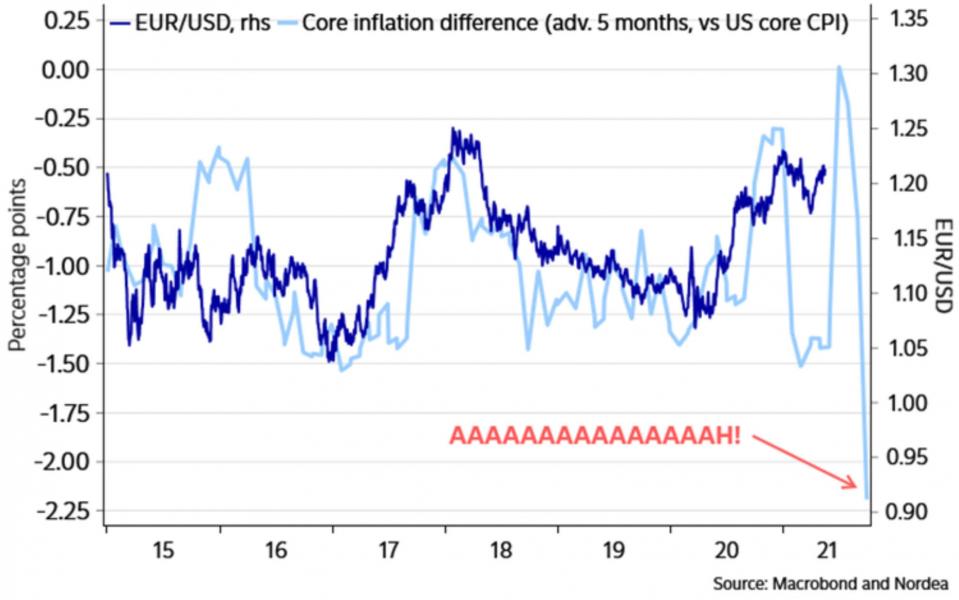
Weakness in EUR/USD in the second half of 2021?
April inflation data from the US has increased pressure on the Fed. The rise in inflation suggests that over the summer the US economy is likely to overheat. This means that the Fed may need to change its dovish signal to a more neutral one, or perhaps even a bit hawkish.
Everyone at the Fed, and some other central bankers around the world, have suggested that the recent spike in inflation is only transitory. Specifically, they see it fading later this year or early next year.
As the above chart shows, if this is the case, the EUR/USD religiously tracks the differential between expectations and underlying inflation. Over the past few years, it has not missed a single change.
Therefore, if we are to interpret the future movement of the EUR/USD based solely on the above chart, one of two things could happen. Either EUR/USD falls to 1.05, then jumps to 1.30, followed by a move below 0.9, or it simply falls below parity. In either case, the correlation suggests a move lower in the coming months, despite the pair's strength over the past two months.
"Anything worth having is worth going for - all the way." - J.R. Ewing
Offline
Pages: 1
- Index
- » Analyses / Forecasts (by major banks and brokers)
- » EUR/USD: the pair is closely following the US consumer index