You are not logged in.
Pages: 1
- Index
- » Analyses / Forecasts (by major banks and brokers)
- » USD/JPY: is the yen losing its status as a refuge currency?
#1 21-06-2021 09:10:34
- johnedward
- Admin & Trader

- From: Paris - France
- Registered: 21-12-2009
- Posts: 3861
- Website
USD/JPY: is the yen losing its status as a refuge currency?
USD/JPY: is the yen losing its status as a refuge currency?
For decades, the Japanese yen has represented a safe haven status in financial markets. Has the virus situation changed the role of the yen in investors' decisions?
Safe haven status in financial markets belongs to assets that act as a store of value under stressful market conditions. The JPY has been such a safe haven for decades, especially in the face of equity weakness.
Specifically, when stocks fall, investors find a safe haven in the Japanese yen. There are various explanations for this phenomenon, and one of the most plausible is the behaviour of Japanese investors, who tend to put most of their money abroad.
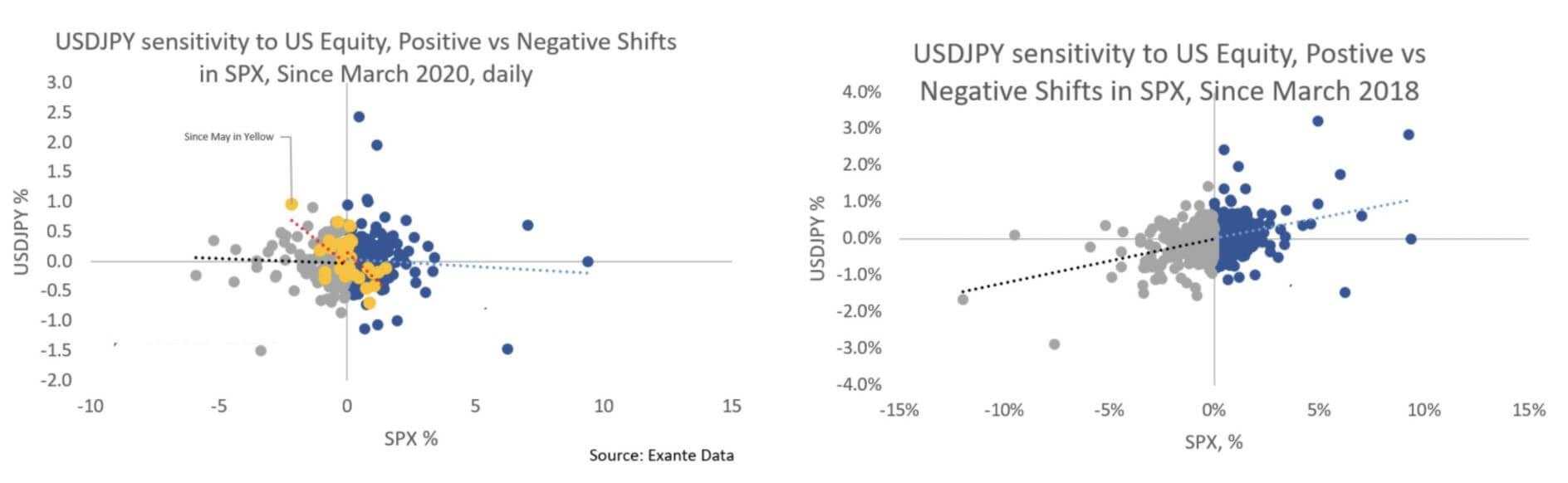
But more recently, the sensitivity of USD/JPY to US equities has shifted. It has changed since the virus shock, and now it seems to have reversed, as lately the pair has a negative correlation with US stock markets.
More money invested abroad by Japanese investors
It is known in the international financial community that Japanese investors have more money invested abroad than in the domestic markets. This is why Japan's net international investment position tends to turn negative during periods of falling stock markets.
Another way of looking at Japan's net international investment position is as the difference between what Japanese people invest abroad and what foreigners invest in Japan. To get an idea, this difference is the largest in Japan, reaching over $3.4 trillion in the second quarter of last year.
We can see that the USD/JPY pair fell as Japan's net international investment position declined. This is because Japanese investors were spooked by the decline in international financial markets and sold their foreign assets. In doing so, they sold their participation in the US stock market and the USD to buy JPY and repatriate funds.
This worked for many years, but it seems to have suddenly stopped. Japanese investors are no longer selling foreign assets in times of market turmoil, which is one reason why the USD/JPY correlation with US equities has changed.
We will soon know if this new behaviour is here to stay or if it is simply a reaction to the virus and the monetary and fiscal policies that followed. In the meantime, investors should be aware that trading USD/JPY in the same manner as in the past 20 years may no longer work.
"Anything worth having is worth going for - all the way." - J.R. Ewing
Offline
Pages: 1
- Index
- » Analyses / Forecasts (by major banks and brokers)
- » USD/JPY: is the yen losing its status as a refuge currency?