You are not logged in.
Pages: 1
- Index
- » Analyses / Forecasts (by major banks and brokers)
- » EUR: Should you buy the euro, now that its pairs are falling?
#1 16-11-2021 17:36:31
- johnedward
- Admin & Trader

- From: Paris - France
- Registered: 21-12-2009
- Posts: 3861
- Website
EUR: Should you buy the euro, now that its pairs are falling?
EUR: Should you buy the euro, now that its pairs are falling?
The euro is down across the board, losing ground against most of its peers. The single currency is expected to remain weak in the coming weeks.
The common currency has had a terrible month - it is down on the dashboard, with no end in sight to the decline. The euro is down against the world's reserve currency, the U.S. dollar, but also against other G10 currencies, such as the Japanese yen, the Canadian dollar or the Australian dollar.
In fact, developments in Europe do not justify a long position on the common currency. On the one hand, the European Central Bank maintains its accommodative stance, unlikely to tighten monetary policy before other central banks. On the other hand, winter is coming and Europe is dependent on energy from Russia, making its economies vulnerable to any disruption in natural gas supplies.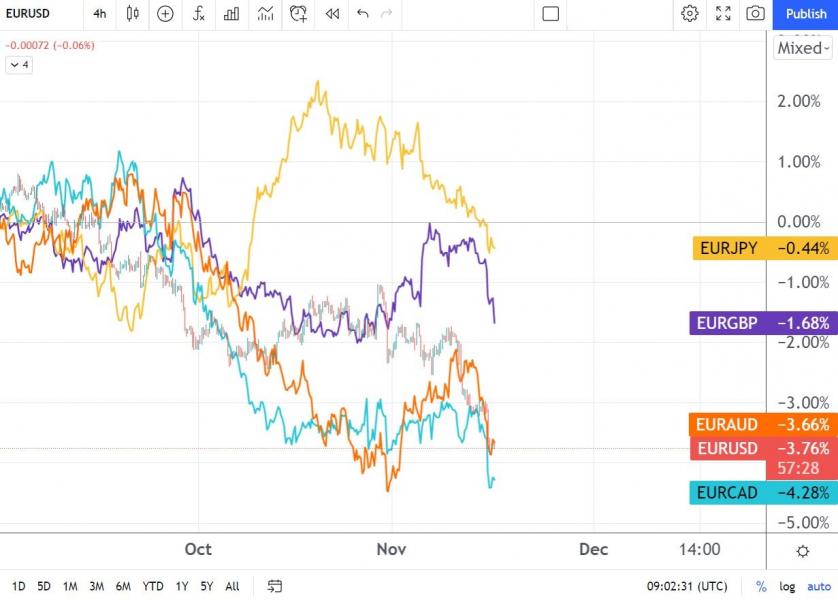
3 reasons to avoid the Euro
The first thing that comes to mind is the divergence between the Federal Reserve and other central banks, such as the Reserve Bank of Australia or the Bank of Canada, regarding their monetary policy plans. Literally every other major central bank is talking about tightening monetary policy, while the ECB sees no reason to do so. So, from that perspective, the euro should have a hard time recovering.
Second, there is another divergence to consider when comparing the euro with the U.S. dollar: inflation. Underlying inflation is much higher in the U.S. and, ironically, this is in the dollar's favor. The implications are that the Fed will be forced to tighten much faster than expected; thus, the markets view the divergence as bullish for the dollar.
Finally, virus infections are on the rise again in Europe. The virus has seasonality and in some European countries some sort of containment has already been announced. Despite the relatively higher vaccination rates in most Western European countries, the fear of a new wave of viruses is increasing as Christmas approaches. Therefore, further lockdowns would only mean a decrease in European economic output, a negative for the common currency.
Overall, the EUR appears weak, and the weakness is expected to persist in the future. Those willing to take the other side of the trade should think about what all of the above means for the ECB.
"Anything worth having is worth going for - all the way." - J.R. Ewing
Offline
Pages: 1
- Index
- » Analyses / Forecasts (by major banks and brokers)
- » EUR: Should you buy the euro, now that its pairs are falling?