You are not logged in.
Pages: 1
- Index
- » Trading Platforms
- » Are independent "liquidity bridges" being squeezed out by Metaquotes?
#1 04-05-2026 21:39:21
- johnedward
- Admin & Trader

- From: Paris - France
- Registered: 21-12-2009
- Posts: 3915
- Website
Are independent "liquidity bridges" being squeezed out by Metaquotes?
Are independent "liquidity bridge" suppliers being squeezed out by MetaQuotes?

First, a few definitions to understand what we're going to talk about:
🔹 MetaQuotes is the company that creates MetaTrader 4 (MT4) and MetaTrader 5 (MT5), the most widely used trading platforms in the world for online brokers (forex, CFDs, etc.).
🔹 A broker is the intermediary that allows an individual to buy or sell currencies, stocks, or commodities.
🔹 A liquidity provider is a large bank or financial institution that offers buy and sell prices on the markets.
🔹 And the "liquidity bridge"? It's the software that connects the broker's platform to the liquidity providers. Imagine it as a cable that links the shop (the broker) to the warehouse (the financial markets). Without this cable, traders' orders cannot be executed. For years, this "cable" role was filled by independent third-party companies.
What's changing: MetaQuotes enters the fray with "Ultency"
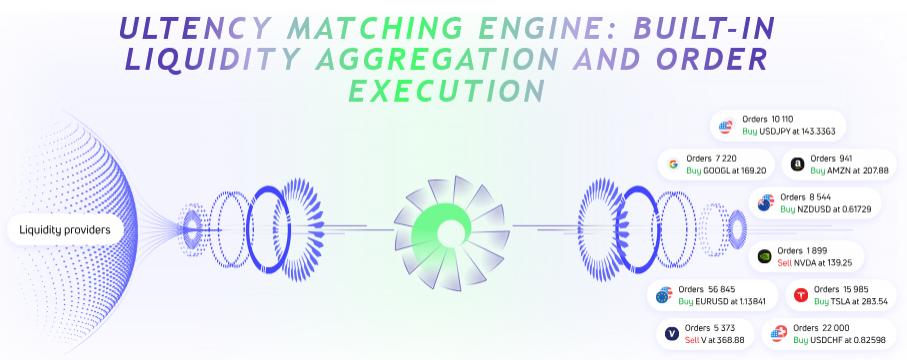
In 2025, MetaQuotes launched Ultency, its own liquidity bridge integrated directly into MT5. In doing so, it is encroaching on a market that was previously reserved for other specialized companies.
The big news is the price: Ultency charges only $1 per million dollars traded - a very low rate compared to industry standards. Traditionally, bridge providers charge based on volume: the more the broker trades, the higher the bill.
Why such a low price? Constantinos Theodolou, MetaQuotes' Chief Commercial Officer, explains it clearly: the goal is not to make a profit on this product, but to attract more brokers to the MT5 ecosystem, increase trading volumes, and strengthen the entire system.
💡 In short: Ultency is a kind of loss leader. MetaQuotes isn't looking to make money directly from it, but rather to build loyalty among brokers to its platform.
Why MT5 is at the heart of it all
MT5 now represents 62% of retail trading volume on MetaQuotes platforms (compared to 38% for MT4, which is declining). And Ultency only works with MT5. MetaQuotes is therefore taking advantage of MT5's growing popularity to offer an all-in-one solution: platform + integrated liquidity bridge.
The advantage for a broker? Operational simplicity. Rather than managing multiple software programs from different providers, everything is centralised in one place.
MetaQuotes isn't alone in this strategy
Other players have adopted a similar approach:
Match-Trade Technologies offers its liquidity bridge for free... but only if the broker also uses its liquidity services. It's a bundled offer: you take everything, or you pay for the bridge separately. Michał Karczewski, CEO of Match-Trade, acknowledges that volume-based pricing can be a heavy burden for smaller brokers whose margins are already tight.
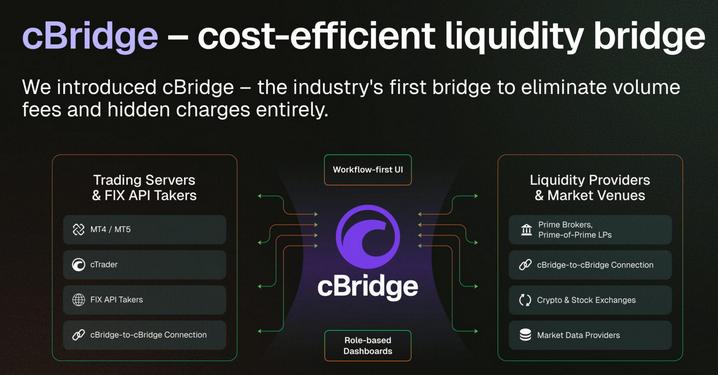
As for Spotware, they launched cBridge in March 2026, with a fixed-price model based on the number of servers and connections, not on trading volumes.
The "walled garden" strategy - a comparison with tech giants
Karczewski draws a striking analogy with major tech companies like Apple or Google: lower barriers to entry, simplify the user experience... and make leaving very expensive. In other words: easy to get in, hard to get out.
A new broker that naturally starts on MT5 and finds a bridge included in the offer has no reason to look elsewhere. This creates real pressure on independent providers who were counting on these new brokers to build their client base.
Defenders of the traditional model
Not everyone believes that "cheaper" automatically means "better."
Tom Higgins, founder of Gold-i (a long-established player in liquidity bridges, now very active in cryptocurrencies), points out that the lowest price often comes with fewer guarantees in terms of reliability and support.
"There will always be someone offering a cheaper product. When you buy a car, you don't buy the cheapest one: you buy the one that suits your needs and your budget."
Elena Petersen, CEO of Your Bourse, advocates for volume-based pricing: for a young broker starting out, paying based on their actual activity allows them to avoid committing to large fixed packages from the outset. And she warns against "flat" tariffs that seem simple on the surface but can hide technical limitations (number of transactions per second, connection caps, etc.).
The "race to zero": who can afford it?
Karczewski makes it clear: if tariffs approach zero, only those players who can "subsidise" themselves through other revenue streams - liquidity, platform licenses, etc. - will be able to afford it.
"Anything worth having is worth going for - all the way." - J.R. Ewing
Offline
Pages: 1
- Index
- » Trading Platforms
- » Are independent "liquidity bridges" being squeezed out by Metaquotes?